
How to Prepare IP Documentation for Business Sales

Updated: May 6
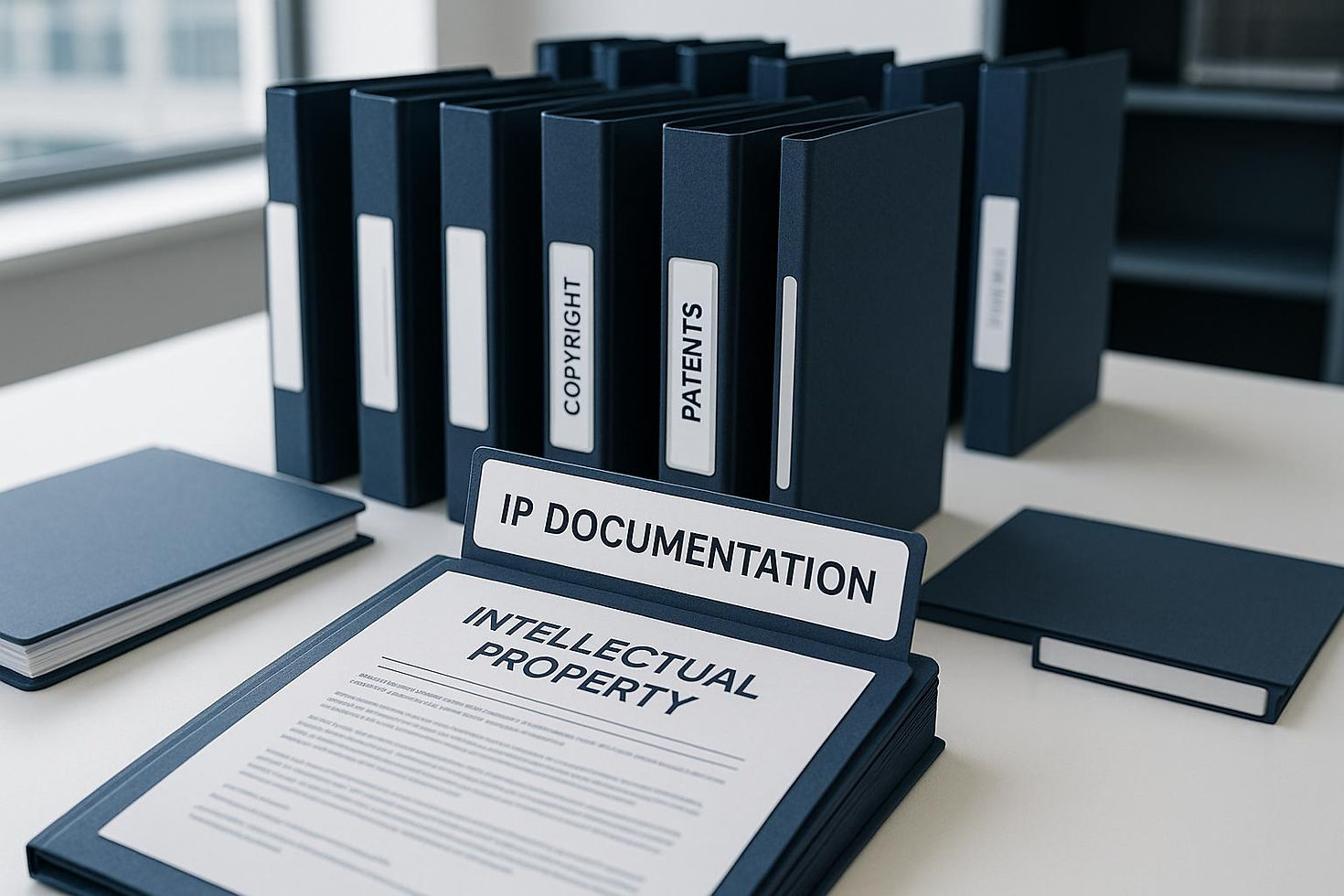
Preparing intellectual property (IP) documentation is a critical step for selling a business. Properly organized IP records can increase your business's value, speed up due diligence, and reassure buyers of clear ownership and legal protections. Here's what you need to know:
Identify and List All IP Assets: Include trademarks, patents, copyrights, trade secrets, domain names, and digital assets.
Verify Ownership and Legal Compliance: Ensure all IP is registered, up-to-date, and owned by the business through proper agreements with employees and contractors.
Organize Supporting Documents: Collect certificates, agreements, and proof of use for each IP type. Use a structured, secure system for easy access.
Prepare for Buyer Due Diligence: Create a clear summary of your IP portfolio, including ownership details, registration numbers, and any licensing agreements.
Starting this process 6–12 months before a sale can help avoid delays, resolve potential issues, and ensure a smoother transaction. Hiring professionals like IP attorneys or due diligence specialists can further streamline the process.
Finding and Listing Your IP Assets
Once you understand the importance of documenting intellectual property (IP), the next step is to systematically identify and list all your IP assets. This list becomes the backbone of your documentation efforts and ensures you capture the full value of your intangible assets when preparing for a sale.
Types of IP to Document
There are four key categories of intellectual property, each serving a unique purpose and requiring specific documentation:
Trademarks: These protect your brand identity, including business names, logos, slogans, and other distinctive elements that customers associate with your products or services.
Patents: Covering technical innovations like inventions, unique processes, manufacturing methods, or design elements, patents grant exclusive rights to use specific technologies, offering a competitive edge that buyers often appreciate.
Copyrights: Safeguarding creative works such as software code, marketing materials, website content, training manuals, and videos, copyrights protect your original creations. While protection is automatic upon creation, formal registration can strengthen ownership claims and simplify the transfer process.
Trade Secrets: These include confidential information that gives your business a competitive advantage, such as proprietary formulas, algorithms, customer lists, pricing strategies, or internal processes. Since trade secrets derive their value from confidentiality, proper documentation and secure access controls are crucial.
Beyond these categories, businesses often hold other valuable digital assets, such as domain names, social media accounts, and databases.
Building an IP Asset List
To create a comprehensive IP inventory, examine every aspect of your business - from customer-facing materials to internal operations. Look at marketing materials, product packaging, website content, and anything tied to your branding. Identify assets eligible for trademark protection and note whether they’re registered with the USPTO or used without formal registration.
For technical assets, document any innovations, processes, or unique methods your business has developed. This could include manufacturing techniques, software algorithms, product designs, or operational procedures that give you an edge. Even if these innovations aren’t patented, they may still qualify as trade secrets.
Your IP asset list should include the following details for each item:
Asset type
Registration status (registered or unregistered)
Registration numbers and dates
Legal ownership
Relevant agreements or licenses
Don’t overlook unregistered IP. Unregistered trademarks and copyrights can still hold significant value and transfer rights. To confirm ownership, review employment and contractor agreements or assignment documents that transfer rights to your business. Buyers will scrutinize these details during due diligence, so having clear documentation is critical.
Organize your inventory systematically - whether through an IP register or a database. A well-structured spreadsheet can work wonders, with columns for asset names, types, registration details, ownership, and supporting documentation. This structured approach makes it easy to update and access your IP inventory during discussions with potential buyers.
IP Assets Often Missed
Some IP assets are easy to overlook, even though they can significantly enhance your company’s value. For example:
Customer Databases and Lists: These can be highly valuable, especially if they include insights into purchasing patterns, preferences, or relationship histories - information that helps buyers maintain business continuity.
Custom Software and Automated Processes: Proprietary tools like a tailored customer relationship management (CRM) system, inventory tracking software, or automated workflows can be key competitive advantages. Documenting these assets ensures they’re recognized during the sale.
Unregistered Trademarks: Business names, product names, taglines, or distinctive packaging elements used consistently in commerce can still be protected under common law. Document their first use and geographic scope to demonstrate their value.
Digital Assets: Domain names, social media handles, and online profiles are increasingly valuable. These assets often require specific transfer procedures and may even be appraised separately during the sale.
Confidential Methods: Supplier relationships, internal procedures, and quality control processes are important intangible assets. While maintaining confidentiality is essential, documenting these assets can be crucial for buyers aiming to replicate your success.
Marketing Materials and Content Libraries: Advertising campaigns, videos, training materials, user manuals, and website content are copyrightable assets. Record details like creation dates, authorship, and any third-party contributions to establish clear ownership.
To ensure nothing is missed, involve key employees in the process. A thorough inventory not only reduces delays during due diligence but also sets the stage for organizing supporting documents in the next phase.
Collecting and Organizing Supporting Documents
Once you've created a detailed inventory of your intellectual property (IP) assets, the next step is to gather all the documents that establish ownership, protection, and transfer rights. This process lays the groundwork for a seamless due diligence review and reassures potential buyers of your business's value.
Required Documents for Each IP Type
Different types of intellectual property require specific documentation to confirm legal ownership and proper management.
Patents: Collect original registration certificates from the USPTO, all assignment agreements showing how ownership was transferred to your business, and receipts for maintenance fees to confirm the patents are active. Include records of any legal disputes or infringement claims. If employees or contractors developed the patents, ensure you have invention assignment agreements transferring their rights to your company.
Trademarks: Focus on proving both registration and active use in commerce. Gather USPTO registration certificates, renewal documents, and evidence of ongoing use, such as advertising materials, product packaging, and sales records. Include trademark assignment agreements, licensing arrangements with third parties, or coexistence agreements if applicable. For unregistered trademarks, compile evidence of first use in commerce, marketing efforts, and documentation supporting common law protection.
Copyrights: Include registration certificates (if applicable), copyright assignment agreements, and any licensing agreements. For software, add development contracts, programmer assignment agreements, and records detailing when and by whom the code was created.
Trade Secrets: Since trade secrets rely on confidentiality, collect all non-disclosure agreements (NDAs) signed by employees, contractors, and business partners. Include internal policies for safeguarding confidential information, access logs for sensitive materials, and employee handbooks outlining trade secret protocols. Document your security measures, such as password-protected systems, restricted access, and confidentiality training records.
Additionally, gather supporting documents for digital assets like domain name registrations, proof of social media account ownership, and website content agreements. For joint ventures or partnerships, include collaboration agreements, shared IP ownership documents, and any consent forms for transferring jointly owned assets.
Organizing Documents for Easy Access
An organized document system not only saves time but also strengthens buyer confidence. Arrange your documents into a structured due diligence package with clearly labeled folders for each IP type. Within each folder, create subfolders for individual assets. For instance, under "Trademarks", have separate subfolders for each registered mark containing its registration certificate, renewal documents, and usage evidence.
Maintain both digital and physical backups. Use a secure cloud-based document management system for digital files, and store original documents safely. Create a detailed index listing every document, including its type, creation date, involved parties, and where it’s stored. This index becomes essential when buyers or their legal teams request specific documents.
"Confidentiality enables businesses to maintain their value without operational disruption or internal discord. Our processes factor this priority in each stage." - God Bless Retirement
Keep track of document versions, especially for agreements that have been amended. Clearly label the most recent version and store older versions in a separate folder to avoid confusion. For licensing and assignment documents, organize them chronologically and include summaries of key terms, making it easier for buyers to evaluate financial obligations and benefits.
When sharing documents, prioritize security. Use encrypted file-sharing services or secure data rooms to track access. Set up different access levels within your system - for example, share basic registration certificates early in the process while reserving sensitive trade secret materials for later stages, after buyers sign comprehensive NDAs and show serious intent.
Investing time in organizing your documents can significantly speed up due diligence. For example, a recent transaction with complete and well-structured documentation reduced the review process to under three weeks [5].
Keep your system updated regularly. This ongoing effort ensures your IP documentation is always ready, whether you're preparing for an immediate sale or planning for future opportunities.
Checking Legal Compliance and Transfer Rights
Once you've completed a thorough inventory of your intellectual property (IP), the next step is ensuring each asset complies with legal and transfer requirements. Verifying that your IP is in good legal standing and ready for transfer helps prevent disputes down the road. This preparation also simplifies ownership resolution and ensures smooth documentation for the transfer process.
Confirming IP Registration and Protection
Start by auditing your IP assets to confirm their registrations are current and protected. This involves reviewing relevant databases and documentation.
For patents, check the USPTO database to verify that maintenance fees are up to date [1]. Also, review the patent claims to ensure they cover your core innovations.
When it comes to trademarks, ensure all brand names, logos, and taglines used in your business are registered with the USPTO and are active [1]. Double-check renewal dates to avoid lapses, and keep documentation that shows these trademarks are actively used in commerce.
Although copyrights don’t always require registration for protection, registering creative works with the U.S. Copyright Office strengthens your ownership claim and simplifies the sales process [1]. Confirm that your business is listed as the copyright owner in all registrations.
For trade secrets, check that strong confidentiality measures are in place. This includes having signed non-disclosure agreements (NDAs) with employees and contractors, implementing restricted access protocols, and maintaining documented security procedures.
Aim to complete this verification process 6 to 12 months before selling your business. This timeline allows you to address any gaps or deficiencies, as weak protection can lower the perceived value of your IP [1][2].
Resolving Ownership and Licensing Problems
After confirming registrations, focus on clarifying ownership and licensing details. Make sure your business - not individual contributors - owns all IP rights [1]. Review agreements with employees, contractors, and freelancers to ensure they include clauses that assign IP ownership to your business.
Gather assignment agreements from anyone involved in creating or contributing to your IP, including employees, freelancers, and consultants [1]. If IP was developed before formal agreements were in place, secure retroactive assignments from the original creators to avoid any transfer issues.
Next, review all licenses you've granted to third parties. This includes exclusive and non-exclusive licenses, as well as sublicensing arrangements [1]. Identify any licenses with change-of-control clauses that might require consent or could be terminated during the sale process [2].
For IP your business licenses from external sources, check whether these licenses are transferable. If they aren’t, contact the licensors early to understand the requirements and obtain necessary approvals [1].
Additionally, investigate whether any liens or security interests are tied to your IP, such as those from financing agreements or collateral pledges [3]. Address any pending litigation or disputes related to IP ownership or infringement, as these could limit the buyer's ability to use the IP freely [1].
If any IP is co-owned, communicate with co-owners about the sale and resolve issues through buyouts or written agreements. Resolving these matters before the sale avoids potential post-closing disputes or breach-of-contract claims [1]. If certain licenses or rights can’t be transferred, work with the buyer to assess the impact and adjust the purchase price accordingly.
Getting Ready for IP Transfer
Each type of IP requires specific documentation for transfer [1]. Preparing these documents in advance will help prevent delays during the closing process.
For trademarks and service marks, create formal assignment forms that clearly identify the mark, describe the associated goods or services, and record the transfer with the USPTO to make it official [8].
Patent assignments must include detailed information such as patent claims, numbers, and any related continuation or provisional applications [1]. Recording these assignments with the USPTO ensures constructive notice of the transfer.
Copyright assignments should specify the works being transferred, including titles, creation dates, and registration numbers (if applicable) [1]. Recording these assignments with the U.S. Copyright Office establishes a clear chain of ownership.
For trade secrets and confidential information, assignment agreements should define what constitutes the trade secret, outline protection measures, and include confidentiality provisions that remain in effect after the sale [2]. This ensures ongoing protection.
When transferring software code and digital assets, assignment agreements should list all source code, object code, documentation, and related materials being conveyed [1].
All assignment agreements should include representations and warranties confirming ownership, freedom from encumbrances, and the right to transfer the IP [2]. The purchase agreement should also feature detailed schedules of all IP assets being transferred, categorized by type and including registration numbers and dates where applicable [7].
To ensure accuracy, consult experienced legal counsel to finalize these agreements. Each type of IP has unique transfer requirements, and proper documentation is critical for protecting both parties involved. This preparation ensures your IP assets are ready for buyer review and due diligence.
"Confidentiality enables businesses to maintain their value without operational disruption or internal discord. Our processes factor this priority in each stage." - God Bless Retirement
God Bless Retirement offers access to Certified Public Accountants specializing in Corporate, M&A, and Tax Law, along with Due Diligence Specialists. Their expertise can help you navigate the complex legal and financial aspects of transferring IP during a business sale.
sbb-itb-61cf270
Getting Ready for Due Diligence and Buyer Review
Once your IP assets are organized and meet legal standards, the next critical step is preparing for buyer review. This phase, known as due diligence, allows buyers to verify your IP claims and assess any potential risks. Being well-prepared can streamline the process and help you maintain your desired asking price. At this stage, creating a clear, concise documentation summary becomes essential.
What Buyers Look for During IP Due Diligence
Buyers typically follow a checklist to identify any issues that might impact their investment. Anticipating their concerns and preparing your responses can save time and avoid unnecessary delays.
One of the first things buyers will examine is proof of ownership. This includes registration certificates for your patents, trademarks, and copyrights, as well as assignment agreements from all contributors involved in developing the IP assets.
Another key focus is your litigation history. Buyers will want to see records of any past or ongoing legal disputes related to your IP, such as infringement claims, opposition proceedings, or licensing disagreements [1][6]. Even resolved cases can influence their decisions, so being upfront about your legal history helps build trust and avoids surprises.
The scope and duration of IP rights also play a big role in a buyer's evaluation. They’ll review patent claims to confirm what innovations are protected, check trademark registrations to ensure they cover relevant goods or services, and assess how much time remains before key protections expire [1][3].
Licensing and encumbrance details are equally important. Buyers will need a full picture of any licenses you’ve granted, exclusive agreements that could limit their future options, and any liens or security interests tied to your IP [1][3].
Finally, buyers will verify that all contributors - whether employees, freelancers, or contractors - have signed assignment agreements, ensuring no one else retains rights to the IP they helped create [1][4].
Creating an IP Documentation Summary
A well-prepared documentation summary builds on your detailed inventory and helps clarify your IP’s value for potential buyers. It acts as a roadmap during due diligence, making the process smoother and more efficient.
Your summary should include a comprehensive table listing all IP assets, complete with their registration numbers, ownership details, and current status [1][4][5]. Organize the information by IP type - such as patents, trademarks, copyrights, trade secrets, and domain names - so buyers can easily navigate the data.
IP Type | Asset Name/Description | Registration Number | Jurisdiction | Owner | Status | Related Agreements | Notes |
Trademark | Brand X Logo | 87654321 | USPTO | ABC Corp | Active | License to Retailer Y | No litigation history |
Patent | Widget Manufacturing Process | 10,123,456 | USPTO | ABC Corp | Active | None | Expires 2031 |
Copyright | Marketing Video Series | TX0008765432 | US Copyright Office | ABC Corp | Active | None | Created 2020 |
Include any relevant agreements, such as licenses, assignments, or non-disclosure agreements, in your summary [4][5]. Be transparent about litigation history, even if resolved, and highlight assets nearing renewal or expiration.
For trade secrets and proprietary processes, describe the protective measures in place without disclosing sensitive details. This could include confidentiality agreements, restricted access protocols, or security measures that safeguard your know-how.
A well-organized summary can significantly cut down due diligence timelines. For example, in 2024, a mid-sized SaaS company in California increased its sale price by 18% after conducting a thorough IP audit and creating a detailed documentation summary. Their streamlined approach shortened the due diligence process to 30 days - half the industry average of 60 days [5].
Seeking Professional Assistance
Once your documentation summary is ready, working with experts can ensure it meets buyer expectations. The complexity of IP due diligence often requires professional guidance to avoid costly mistakes and facilitate a smooth transaction.
IP attorneys can review your documentation, identify potential issues, and address them before buyers raise concerns. Their involvement demonstrates to buyers that you’ve taken IP protection seriously.
Due diligence specialists know exactly what buyers are looking for. They can help you organize your documentation to meet these standards, flag potential red flags, and suggest proactive solutions [2].
Business brokers experienced in IP-heavy transactions can manage the entire process while maintaining your confidentiality. They can handle initial buyer inquiries, coordinate document reviews, and structure deals to maximize the value of your IP.
For example, God Bless Retirement specializes in business sales for companies with under $25 million EBITA. They offer certified valuations and connect you with professionals like CPAs, financial planners, and private equity experts. Their expertise in handling IP-focused deals ensures your documentation aligns with buyer expectations while safeguarding sensitive information.
Professional advisors can also draft confidentiality agreements and limit document access to vetted buyers. This is particularly important when sharing trade secrets or proprietary processes during due diligence [2].
To avoid last-minute hurdles, it’s best to start preparing 6–12 months before the sale. This gives you ample time to address any issues and ensure your IP documentation supports your business goals [1][2].
Key Points for Preparing IP Documentation
Getting your intellectual property (IP) documentation in order for a business sale takes careful planning and precision. Start by creating a detailed inventory of all your IP assets, including any less obvious ones. This step lays the groundwork for ensuring everything is legally compliant and ready for a seamless transfer.
Once you've listed all your assets, confirm that ownership is properly assigned. Make sure every IP asset is legally tied to your business through agreements with employees and contractors. This not only avoids potential disputes down the road but also reassures buyers that the ownership is clear and uncontested[1][3][4]. After verifying ownership, organize your documents in a way that makes them easy to access and review.
Store these documents in a centralized, well-labeled digital repository. A clear and efficient system helps streamline the due diligence process, saving time and preventing unnecessary delays for potential buyers[4][5][6].
If your IP portfolio is particularly complex, consider bringing in experts. Business brokers who specialize in IP-heavy transactions, such as God Bless Retirement, can connect you with professionals like IP attorneys, due diligence specialists, and valuation experts. Their expertise ensures your documentation aligns with buyer expectations and supports your broader business objectives[2].
Properly prepared IP documentation not only confirms ownership and transferability but also boosts buyer confidence and can increase the value of your business. On the flip side, incomplete or unclear documentation might lead to lower valuations or even jeopardize the transaction because of perceived risks[1][2][4].
FAQs
What are the risks of not organizing IP documentation properly when selling a business?
Failing to get your intellectual property (IP) documentation in order before selling your business can create serious problems. For starters, it might slow down or even jeopardize the sale, as disorganized IP records can make potential buyers question the overall management of your business. On top of that, your business could be undervalued if buyers can't confirm the ownership or scope of your IP assets. And perhaps most concerning, incomplete or unclear IP records might lead to legal disputes after the sale, especially if ownership or usage rights come into question.
To steer clear of these issues, make sure your IP assets - like trademarks, patents, copyrights, and trade secrets - are thoroughly documented, current, and easy to access. This not only smooths the sales process but also reassures buyers about the value and credibility of your business.
What are the benefits of working with IP attorneys or due diligence experts when preparing intellectual property documentation for a business sale?
When selling a business, collaborating with IP attorneys or due diligence specialists can make preparing intellectual property documentation much more efficient. These experts ensure your IP assets are clearly identified, properly recorded, and legally secured, minimizing potential complications during the transaction.
Additionally, they can spot gaps or risks in your IP portfolio, giving you the chance to resolve them ahead of time. Their knowledge helps ensure your documentation meets legal requirements, instilling confidence in buyers and contributing to a smoother sales process.
What should a business do if they find gaps in their intellectual property protection while preparing for a sale?
If you discover gaps in your intellectual property (IP) protection while preparing to sell your business, it’s crucial to address them quickly to avoid complications. The first step? Consult with an experienced intellectual property attorney. They can assess the situation, identify weaknesses, and guide you on securing additional protections, such as filing for trademarks, patents, or copyrights where necessary.
It’s also important to ensure all your existing IP is well-documented and current. This means confirming ownership, renewing any expired protections, and resolving disputes or unclear claims. By taking these proactive measures, you not only boost your business’s value but also provide potential buyers with confidence in its stability and future potential.


