
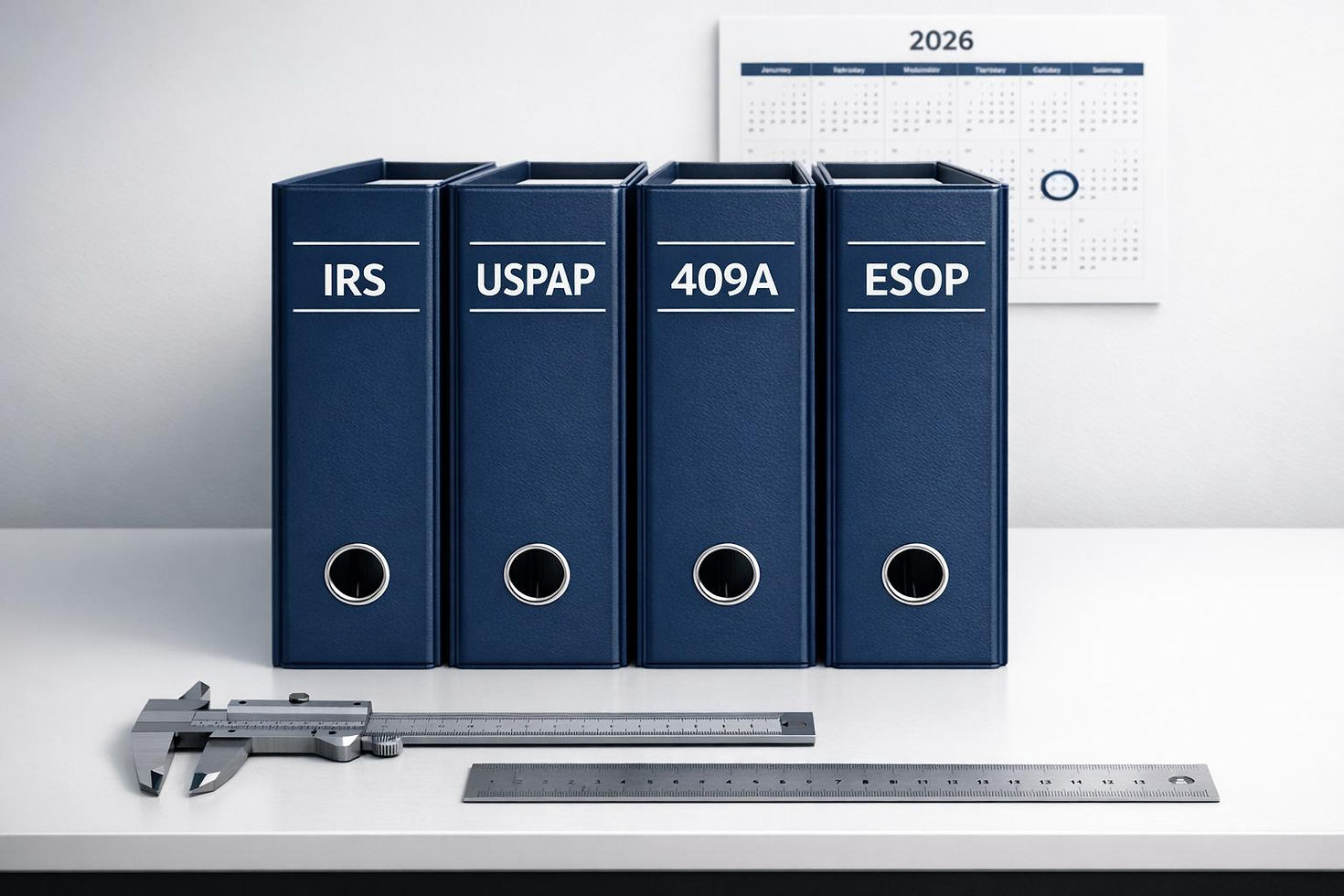
Legal Standards for Business Valuations

Legal standards are the backbone of business valuations, ensuring they meet IRS, court, and regulatory requirements. These valuations aren't just about numbers - they must follow specific frameworks to avoid audits, penalties, or legal challenges. Here’s what you need to know:
Key Frameworks:
Revenue Ruling 59-60: Sets the "fair market value" standard using eight mandatory factors like earning capacity and economic outlook.
Section 409A: Governs stock option valuations, requiring defensible fair market value to avoid tax penalties.
USPAP: Establishes ethical and methodological appraisal standards for defensible valuations.
ESOP Regulations: Mandate independent annual valuations for employee stock ownership plans.
Certified Appraisers: Only professionals with certifications like ASA, ABV, or CVA can produce legally compliant reports. These reports must include detailed documentation and meet strict independence rules.
Consequences of Non-Compliance: Failure to follow these standards can lead to IRS rejections, penalties for appraisers, and increased tax liabilities for business owners. For example, appraisers may face fines up to 125% of their fees for "gross misstatements."
Upcoming Changes: By 2026, ESOP valuation rules will require stricter documentation and transparency, with enhanced oversight for fiduciaries.
To avoid risks, work with qualified professionals who understand these frameworks and stay updated on regulatory changes. Proper valuations protect your business, reduce liabilities, and ensure compliance.
Legal Frameworks for Business Valuations
In the United States, three key legal frameworks are in place to ensure business valuations are accurate, compliant, and defensible.
Section 409A of the Internal Revenue Code
Section 409A governs how private companies value equity compensation like stock options and restricted stock units (RSUs). This regulation requires companies to determine a defensible fair market value (FMV) for common stock to avoid hefty tax penalties for employees. To gain safe harbor protection, valuations must be conducted by a qualified independent professional using standard valuation methodologies [7]. For illiquid startups under 10 years old with no public trading, the professional must have at least five years of experience in valuation, investment banking, or private equity [5].
"The IRS must prove the valuation was 'grossly unreasonable' to challenge it. The burden of proof shifts from the company to the IRS." – Transaction Capital LLC [7]
Valuations under Section 409A are valid for 12 months or until a material event occurs - such as new funding rounds, revenue changes of 25% or more, or M&A discussions [6]. Non-compliance can result in a 20% excise tax, interest penalties, and immediate income recognition at vesting [5]. More than 90% of U.S. startups issuing stock options rely on 409A valuations, underpinning a market worth an estimated $500 million annually [6].
Uniform Standards of Professional Appraisal Practice (USPAP)
USPAP sets the methodological and ethical guidelines for valuations, ensuring they can withstand IRS audits, disputes, or litigation [7]. Professionals with designations like Accredited Senior Appraiser (ASA), Accredited in Business Valuation (ABV), or Certified Valuation Analyst (CVA) are required to follow these standards.
"Every valuation adheres to the Uniform Standards of Professional Appraisal Practice. This compliance ensures methodological rigor and defensibility in IRS disputes or litigation." – Transaction Capital LLC [7]
USPAP-compliant reports include detailed documentation, such as data sources, assumptions, and sensitivity analyses, to meet the scrutiny of audits. The IRS gives more credibility to valuations signed by USPAP-certified professionals. These standards also serve as a foundation for equally rigorous requirements in ESOP valuations.
ESOP Valuation Regulations
Employee Stock Ownership Plans (ESOPs) are governed by Department of Labor rules, which mandate annual valuations by independent, qualified appraisers. These rules ensure ESOP transactions reflect fair market value, protecting the retirement assets of employees from potential misvaluation.
The Department of Labor has announced plans for updated regulations in 2026. These changes will increase transparency and broaden the criteria for qualified appraisers performing ESOP valuations. Business owners exploring ESOP structures should collaborate with certified valuation experts who stay informed on regulatory updates to ensure compliance and protect all stakeholders.
sbb-itb-61cf270
Certified Business Valuation Standards
Certification Levels and Standards
Certified valuations must adhere to strict legal standards to ensure they are admissible in court, compliant with IRS regulations, and suitable for financing purposes.
In the United States, certified valuations must follow one or more recognized professional standards, including the Uniform Standards of Professional Appraisal Practice (USPAP) Standards 9 and 10, the AICPA's Statement on Standards for Valuation Services (SSVS No. 1/VS Section 100), and the NACVA Professional Standards [9]. For licensed CPAs, compliance with VS Section 100 is mandated by State Accountancy Boards.
Only certified appraisers - such as those holding ASA, ABV (AICPA), or CVA (NACVA) credentials - are authorized to sign valuation reports [9][10]. For SBA loan applications, appraisers must possess one of the following certifications: ASA, ABV, CVA, CBA, or BCA [11].
Standard/Organization | Key Regulation/Standard Name | Target Audience |
The Appraisal Foundation | USPAP (Standards 9 & 10) | All professional appraisers |
AICPA | SSVS No. 1 (VS Section 100) | CPAs and ABV credential holders |
NACVA | CVA Professional Standards | Certified Valuation Analysts |
IRS | IRM 4.48.4 | IRS personnel and third-party reviewers |
These certifications not only validate the appraisal process but also ensure the report meets the highest standards of legal defensibility.
Court and IRS Admissibility
Certified valuations must follow specific guidelines to be accepted in court or by the IRS. These include strict independence and thorough documentation requirements. Certified reports must explicitly state that the appraiser remains impartial and that their compensation is not influenced by the valuation outcome [3].
"Appraisers will employ independent and objective judgment in reaching conclusions and will decide all matters on their merits, free from bias, advocacy, and conflicts of interest." – Internal Revenue Manual 4.48.4.3.2 [3]
A complete valuation report must detail the property, specify the effective date, outline the purpose of the appraisal, and identify the standard of value applied (commonly Fair Market Value) [3].
"The primary objective of an appraisal report is to provide convincing and compelling support for the conclusions reached." – Internal Revenue Manual 4.48.4.4.1 [3]
For SBA loans exceeding $250,000 (excluding real estate and equipment), an independent valuation is required. These reports are typically completed within 7–10 business days, costing between $2,500 and $5,000. In more complex cases, fees can reach $10,000 [11][12]. In these scenarios, the appraiser must function as an unbiased third party.
God Bless Retirement delivers certified business valuations that comply with these rigorous legal standards. These reports are designed to hold up under IRS audits, litigation, and SBA loan evaluations. Whether for tax filings, mergers, or acquisitions, these valuations are built to meet the demands of various legal and financial contexts. This adherence to stringent standards ensures the credibility and reliability of every report, aligning with the broader regulatory framework discussed earlier.
Consequences of Non-Compliance
Ignoring legal standards in business valuations can lead to serious financial and legal repercussions. The impact goes far beyond having a report rejected - it can result in hefty fines for both the appraiser and the business owner.
Appraiser penalties are particularly steep under 26 USC 6695A. If an appraiser makes a "substantial" or "gross" misstatement, they can face a penalty equal to the lesser of 10% of the tax underpayment or $1,000, or 125% of the fee they received[13]. For example, an appraiser who earns $5,000 for a valuation that doesn’t meet compliance standards could end up with a penalty as high as $6,250. This highlights the importance of adhering to rigorous, defensible valuation practices.
Business owners and taxpayers aren’t off the hook either. An incomplete or non-compliant valuation can lead to IRS rejections, which in turn may result in increased tax liabilities, interest accruals, and penalties.
Compliant vs. Non-Compliant Outcomes
The contrast between compliant and non-compliant valuations couldn’t be clearer:
Context | Compliant Outcome | Non-Compliant Outcome |
IRS Audit | Defensible valuation that may provide safe harbor if deemed more likely than not correct. | High risk of rejection, leading to audit adjustments and potential penalties. |
Court Admissibility | Accepted as expert testimony, following cases like Weinberger v. UOP, Inc. | Credibility issues may cause dismissal as arbitrary or outdated. |
Financial Risk | Limited to standard professional fees. | Appraisers may face penalties up to 125% of their fees, and clients could incur additional tax penalties. |
Methodology | Covers all eight factors of Revenue Ruling 59-60 and uses modern methods like Discounted Cash Flow (DCF). | May rely on outdated or selective methods, such as focusing solely on Book Value. |
For instance, in Weinberger v. UOP, Inc., the Delaware Supreme Court rejected the outdated "Delaware Block" method in a cash-out merger case. The court emphasized that "fair value" must include generally accepted techniques like Discounted Cash Flow (DCF)[8]. Similarly, the Estate of Mandelbaum v. Commissioner case saw the U.S. Tax Court adjust a family's claimed discounts for lack of marketability, settling on a 30% discount due to insufficient evidence supporting the original valuation[2].
Business owners who need certified valuations should ensure their appraisers strictly follow these legal standards. Working with experienced professionals - such as those at God Bless Retirement - can help avoid the risks tied to non-compliance. With penalties clearly outlined and tighter regulations expected by 2026, staying compliant is more important than ever.
Upcoming Standards and 2026 Updates
Big changes are on the horizon for ESOP and business valuations in 2026. Thanks to the SECURE 2.0 Act of 2022, clearer standards are being introduced for what constitutes "adequate consideration" in ESOP transactions, addressing a long-standing gap in the ESOP community’s regulatory framework[14].
DOL ESOP Rule Changes
On January 16, 2025, the Department of Labor (DOL) proposed new regulations that lay out a two-part test for determining "adequate consideration." According to these rules, transactions must meet two criteria: they must reflect the "fair market value" of the stock and result from a "good faith" determination by the fiduciary[15]. This means fiduciaries must ensure the valuation process adheres to strict procedural standards while also being defensible.
"Good faith... entails independent plan trustees or named fiduciaries determining value in accordance with a prudent process designed to ensure a sound conclusion as to the stock's fair market value in conformity with ERISA's fiduciary standards of prudence and loyalty." - U.S. Department of Labor[15]
Fiduciaries now face more stringent documentation requirements. They must show how they selected qualified independent appraisers, oversee the preparation of written valuation reports based on accurate data, and verify the reliability of those reports[15]. To simplify compliance, the new rules also introduce a "safe harbor" exemption for prohibited transactions. This safe harbor makes the independent trustee solely responsible for determining the purchase price, reducing the risk of violations during initial stock purchases[14][15].
Experts at Polsinelli PC caution that the lack of clear guidance in the past has left ESOP sponsors vulnerable to legal challenges:
"Without such guidance, the ESOP community has expressed concerns that plan sponsors, selling shareholders and ERISA fiduciaries could be left exposed to allegations that the ESOP overpaid for shares at the time of the initial transaction through investigations and civil lawsuits brought later with the benefit of hindsight."[14]
The proposed rules are set to take effect 60 days after the final rule is published[15]. For business owners planning ESOP transactions, aligning processes now with these standards is critical.
Potential Impacts on QBI Deductions
The ripple effects of these changes are likely to extend beyond ESOP valuations. Similar scrutiny is expected for Qualified Business Income (QBI) deductions under Section 199A. Since QBI deductions hinge on accurate business valuations - especially when determining reasonable compensation for S-corporation owners - the IRS may adopt similar "good faith" standards for valuation processes in tax contexts.
Business owners claiming QBI deductions should prepare for stricter documentation requirements. This is particularly important when valuations influence calculations like W-2 wages or determine whether a business qualifies as a Specified Service Trade or Business (SSTB). The DOL’s emphasis on thorough, process-driven valuations could set a precedent for how other tax-related valuations are handled.
Enhanced Transparency Requirements
The 2026 updates also bring a stronger focus on transparency and active oversight. Fiduciaries can no longer passively accept valuation reports. Instead, they must verify that appraisals are based on "complete, current, and accurate information" and are reliable enough to support their decisions[15].
"The NPRM takes a principles-based approach in setting out a fiduciary framework for employer stock valuation and proper use and development of appraisals, without purporting to specify precise valuation methods and methodologies." - U.S. Department of Labor[15]
This shift means business owners and brokers need to adopt stricter record-keeping practices and establish formal procedures for selecting and overseeing independent valuation advisors. Since the DOL has been running its ESOP National Enforcement Project since 2005[15], these new standards give regulators clearer guidelines to enforce.
For businesses working with God Bless Retirement on certified valuations, these updates highlight the importance of choosing advisors who not only understand valuation techniques but also stay current with regulatory requirements. The risks of non-compliance - whether through penalties or lawsuits - make it crucial to get the process right from the very beginning.
Conclusion
Business valuations go beyond just calculating a number - they’re about creating a solid foundation that can withstand IRS scrutiny, guide strategic decisions, and shield owners from costly penalties. With established legal standards and the new 2026 ESOP regulations, businesses have clear guidelines to ensure appraisals remain compliant and credible.
Using the wrong valuation methods or failing to disclose necessary details can lead to serious consequences. For instance, the IRS can audit a business interest transfer indefinitely without proper disclosure, bypassing the usual three-year statute of limitations[4]. As Troy Ortiz from Apricity Law explains:
"Failure to adhere to these principles can result in adverse tax consequences, including recharacterized income, penalties, and interest"[1].
While the risks of non-compliance are high, following proper standards offers real advantages. Certified valuations not only minimize risks but also open doors to strategic opportunities. For example, applying discounts for lack of control or marketability - backed by a qualified appraisal - can lower taxable value by 20%–30% or more[4]. Starting the valuation process two to three years before a planned exit also gives business owners time to address critical value drivers, like reducing customer concentration or owner dependence, which can significantly boost sale prices[16]. Additionally, a thorough valuation strengthens your position in negotiations and builds trust with buyers, lenders, and regulators.
As emphasized earlier, adhering to rigorous standards and seeking expert guidance is essential. Tackling these challenges requires professionals who excel in valuation methods and understand evolving regulations. God Bless Retirement offers certified business valuations designed to meet legal requirements while supporting strategic goals. Whether you’re planning a sale, structuring an ESOP, or optimizing estate tax strategies, their family-led approach ensures confidentiality and connects you with a trusted network of CPAs, financial planners, and private equity experts.
FAQs
Which legal standard applies to my valuation?
Revenue Ruling 59-60 sets the benchmark for business valuations in the United States. It defines fair market value as the price a willing buyer and a willing seller, both having reasonable knowledge of all relevant facts, would agree upon in an arm’s length transaction. This ruling serves as the cornerstone for valuation practices across the country.
When do I need a new 409A valuation?
You’ll need a new 409A valuation anytime there’s a material change that could affect your company’s fair market value. These changes often happen during events like fundraising, periods of rapid growth, or major structural shifts. Generally, a 409A valuation is valid for up to 12 months, as long as no significant events take place during that period.
What makes a valuation report “defensible” to the IRS or a court?
A valuation report is considered "defensible" when it is impartial, thoroughly documented, and aligns with established legal standards, like IRS Revenue Ruling 59-60. To achieve this, the report must include a detailed analysis, follow the eight-factor framework, and involve qualified appraisers. These elements are essential to ensure the report meets regulatory guidelines and can hold up under scrutiny from the IRS or in court.


